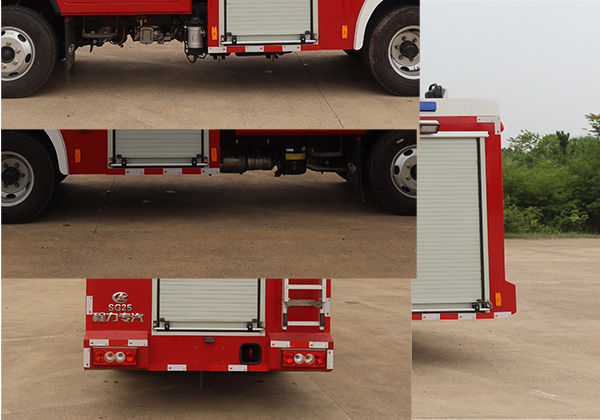
Water Tank Fire Truck
1. Compact & Agile Design
Featuring a streamlined structure and moderate size, the fire truck offers excellent maneuverability for navigating narrow urban streets, crowded communities, and confined industrial sites with ease.
2. Fully-Equipped & Ready to Respond
Comes with a complete set of firefighting tools and systems, ensuring it is always prepared for immediate deployment to fires in enterprises, key facilities, and residential areas.
3. Rapid Emergency Response
Designed for quick dispatch and on-scene readiness, enabling prompt intervention during early stages of fire incidents to help minimize damage and enhance public safety.
4. Strong Operational Flexibility
Balances size and capability effectively, allowing it to operate efficiently in diverse environments—from dense city blocks to industrial parks—without the limitations of larger fire apparatus.
5. Reliable Performance in Critical Situations
Built with robust components and stable firefighting systems, delivering dependable performance for core fire suppression, rescue support, and initial fire control tasks.
6. Ideal for Municipal & Industrial Fire Protection
Serves as a versatile and cost-effective solution for city fire brigades, industrial fire units, and community fire stations that require a responsive, multi-role firefighting vehicle.
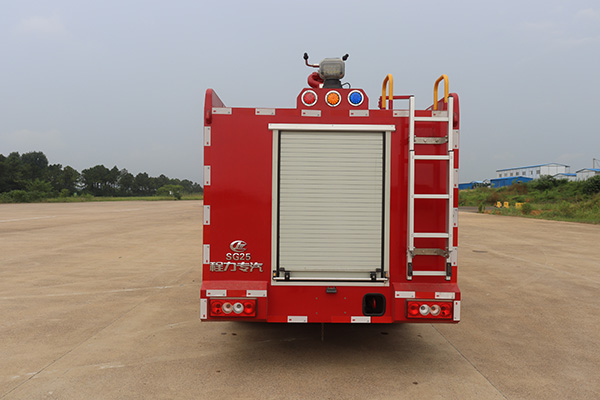
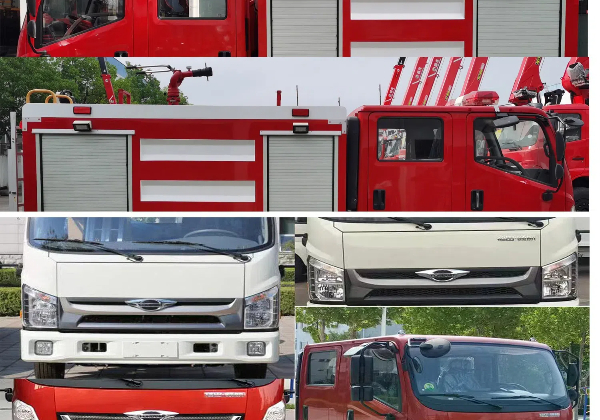
Double row cab (with 3+3 people in the cab), the vehicle has an exposed tank structure. The front of the box is an equipment box, the middle is a water tank, and the rear is a pump room. The carrier tank body is made of high-quality carbon steel material (304 stainless steel material can also be optionally installed), and the entire box body is equipped with Chengli high-end electrophoresis technology. It is elastically connected to the chassis, with an actual water capacity of 3 cubic meters (announced volume of 2.6 cubic meters), equipped with CB10/30 fire pump, rated flow rate of 30L/S, and PS30 vehicle fire monitor installed on the roof. The biggest feature of this car is its small liquid capacity of up to 3 cubic meters, good handling, and easy maintenance. Widely used in police and fire departments, factories, mining enterprises, communities, docks and other places to extinguish large oil fires and general material fires.
Small combat capabilities can be formed in a timely manner to extinguish initial fires and evacuate personnel. Widely applicable to fire rescue stations, government
Full time fire brigade of the government, full-time fire brigade of enterprises, etc.
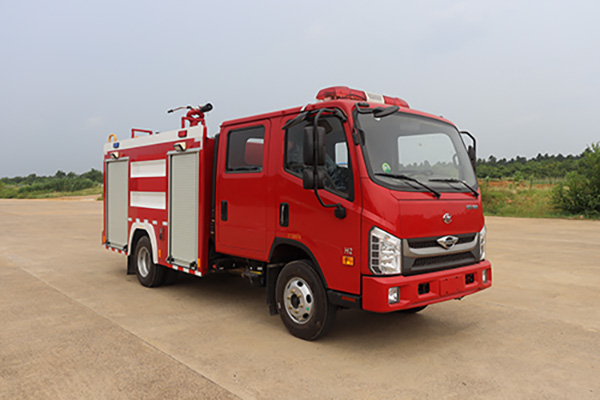


【Technical parameters of the entire vehicle】 | |||
Product trademark | Xiangnongda brand | Announcement batch | 388 |
Product Name | Product model | CB138826302 | |
Total mass (Kg) | 7100 | Tank volume (m3) | |
Rated load capacity (Kg) | 2600 | External dimensions (mm) | 6385x2090x2870 |
Curb weight (Kg) | 4050 | Maximum Speed | 95 |
Cab capacity (persons) | 3 | Axle load (Kg) | 2385/4715 |
Approach Angle/Departure Angle (degrees) | 26/15 | Front/rear suspension (mm) | 1130/1895 |
remarks | Optional red flashing light. Water tank capacity: 2.600 cubic meters. The water tank is a special-shaped tank with front dimensions of 900x870x1105mm and rear dimensions of 840x2000x1105mm. Integrated side rear protection structure, rear protection height above ground: 454mm. The ABS production enterprise is Guangzhou Ruili Kemi Automotive Electronics Co., Ltd., with the model CM4XL-4S/4M. The main specialized devices include fire pumps and fire cannons. The lighting fixtures are only used during work. Optional cab with chassis | ||
【Chassis Technical Parameters】 | |||
Chassis Model | BJ1076VEADA-51 | Chassis name | Truck chassis |
Trademark name | Futian brand | manufacturing enterprise | Foton Motor Co., Ltd |
Number of axes | 2 | Number of tires | 6 |
Wheelbase (mm) | 3360 | ||
Tire specifications | 7.00R16LT 14PR,7.50R16 12PR,7.50R16LT 12PR | ||
Number of steel plate springs | 3/6+6 | Front wheel base (mm) | 1550,1575,1585 |
Fuel type | diesel oil | Rear wheel base (mm) | 1485,1590,1605 |
Emission standards | GB17691-2018 National VI | ||
Engine model | Engine manufacturing enterprises | Emissions(ml) | Power (Kw) |
Q23-115C60 Q28-130C60 YN25PLUS10 | Anhui Quanchai Power Co., Ltd Anhui Quanchai Power Co., Ltd Kunming Yunnei Power Co., Ltd | 2300 2800 2499 | 118 125 121 132 |
Structure:
Frame welding, with longitudinal and transverse anti sway plates installed inside the tank to reduce the impact of water in the tank on the tank during vehicle operation; The front and rear wall panels of the tank are folded with trapezoidal ribs to provide sufficient strength to the tank. A quick opening manhole is installed on the top of the tank to facilitate the entry and exit of maintenance personnel. There are devices and filters inside the tank to prevent the water pump from absorbing water and forming vortices, which can affect the flow rate. The tank is equipped with a stainless steel floating ball liquid level indicator, which can display the capacity of the fire extinguishing agent in the tank through the liquid level gauge on the dashboard; There is a drain outlet with a ball valve at the bottom of the tank. The tank is equipped with one 76mm overflow pipe and one 76mm injection port on each side of the carriage, which is convenient for other vehicles to supply water and add liquid.
Equipment:
1 manhole with quick locking and opening device. 1 sewage outlet with stainless steel ball valve. 1 liquid level indicator. Two water injection ports (one on each side) process: welding is firm and reliable, removing and cleaning defects such as slag inclusion and virtual welding; After welding, the tank body should undergo a 24-hour hydrostatic pressure test to ensure no leakage.

Frequently Asked Questions (FAQ): Medium-Sized Fire Truck
1. What defines a "medium-sized" fire truck?
A medium-sized fire truck offers an optimal balance between size and capability. It is more agile and maneuverable than large aerial or pumper trucks, yet carries more comprehensive equipment and water/foam capacity than smaller rapid intervention vehicles (RIVs), making it a versatile core-response unit.
2. What are its primary functions and applications?
It is designed as a multi-role initial attack and fire suppression vehicle. Key applications include responding to structural fires in communities and enterprises, vehicle fires, supporting rescue operations, and providing fire protection for key infrastructure units.
3. What are its key advantages in urban or confined environments?
Its compact structure and strong maneuverability allow it to navigate narrow streets, dense residential areas, and congested industrial sites more efficiently than larger apparatus, ensuring a faster and more agile response where access may be limited.
4. What standard equipment and configurations does it typically include?
It comes as a fully-configured unit, typically equipped with a fire pump (with specified water/foam capacity), a water tank, hose reels, ladders, a comprehensive set of hand tools, breathing apparatus (SCBA) storage, and lighting/power generation systems.
5. How does it ensure prompt emergency response?
The combination of a ready-to-roll configuration, swift acceleration, and excellent maneuverability allows for rapid dispatch and arrival on scene. Its design enables crews to begin firefighting or rescue operations immediately upon arrival.
6. Is it suitable for both municipal and industrial fire brigades?
Absolutely. It serves as an ideal primary response vehicle for municipal fire departments in small to medium cities and towns, as well as for industrial fire brigades, airport crash teams, and dedicated facility protection units needing a robust, self-contained response vehicle.
7. What are typical pump and tank capacities?
Capacities vary by model, but a typical medium-sized pumper may feature a pump rated between 1,500 to 2,500 GPM (5,700 to 9,500 L/min) and a onboard water tank ranging from 500 to 1,500 gallons (1,900 to 5,700 liters).
8. What kind of crew and training does it require?
It is typically operated by a standard crew of 3-4 firefighters. Operators require certified fire apparatus driver/operator training, and all crew members must be trained in pump operations, fire attack tactics, and the use of all onboard equipment.
9. What are the main maintenance considerations?
Regular maintenance is crucial and includes daily/weekly checks of the pump, engine, and all emergency systems, along with scheduled servicing of the chassis, pump, and all firefighting equipment as per NFPA or local standards.
10. What customization options are available?
While fully-configured, it can be customized with options such as compressed air foam systems (CAFS), extended water tanks, specific hose loads, additional rescue tools, command and communication upgrades, and specialized storage compartments to meet specific operational needs.