How does a garbage truck compactor work?
The Core of Efficiency: An In-Depth Look at How a Modern Garbage Truck Compactor Works
In the global waste management industry, efficiency is not just a goal—it’s an economic and environmental imperative. As urbanization intensifies and landfill costs rise, the demand for smarter, more capable waste collection vehicles has never been greater. At the heart of this evolution lies a critical piece of engineering: the garbage truck compactor. For municipal authorities, private waste management companies, and recycling operators, understanding how a garbage truck compactor works is key to optimizing routes, reducing costs, and improving service sustainability.
The global refuse truck market, valued at over USD 10 billion, is steadily growing, driven by stringent environmental regulations and the need for operational efficiency. A significant trend is the shift towards high-compaction ratio refuse trucks and automated side loader garbage trucks, which rely on advanced compaction mechanisms to handle higher volumes with fewer trips. This article will dissect the working principle of garbage truck compaction, explore the technologies behind it, and explain why this knowledge is crucial for making informed commercial garbage truck purchasing decisions.
1. The Fundamental Principle: From Volume to Density
Before diving into mechanics, it’s essential to grasp the core concept. A garbage truck compactor does not merely collect waste; it densifies it. The primary goal is to increase the weight and density of the load within the truck’s storage body, thereby maximizing payload capacity before a trip to the transfer station or landfill is required.
This is quantified by the compaction ratio—the ratio of the volume of loose waste to the volume of compacted waste. For example, a compaction ratio of 4:1 means the compactor reduces the waste to one-quarter of its original volume. Higher ratios, often seen in modern rear loader compactor trucks and sealed waste compactor systems, translate directly into fewer collections, lower fuel consumption, and reduced operational costs.
2. Anatomy of a Compaction System: Key Components
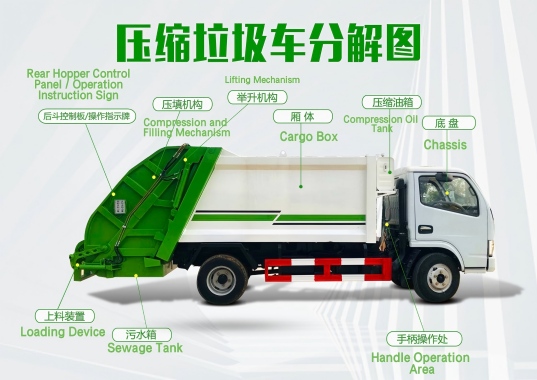
A modern compaction system is an integrated unit, typically comprising the following key components:
2.1 The Hydraulic Power Unit (HPU)
The HPU is the “engine” of the compactor. It consists of a hydraulic pump (driven by the truck’s engine via a Power Take-Off (PTO)), a hydraulic fluid reservoir, valves, and filters. It converts mechanical power into pressurized hydraulic fluid, which provides the immense force needed for compaction.
2.2 The Packing Panel/Cylinder
This is the moving wall that does the actual work. A large, heavy-duty hydraulic cylinder pushes the packing panel through the loading hopper into the main body. Its powerful, sweeping motion crushes and pushes the waste towards the front of the truck. In many semi-automated waste compaction systems, this cycle is triggered automatically once waste is loaded.
2.3 The Hopper and Ejection System
The hopper is the opening where waste is initially dumped. Its design is crucial for safety and efficiency. After compaction and upon arrival at the disposal site, a separate ejector panel (or a telescopic cylinder) moves forward to push the entire compacted load out of the body for quick and clean unloading.
2.4 The Body and Container
The main body is a reinforced, often corrugated, steel container designed to withstand immense internal pressure. Modern designs focus on lightweight materials for garbage truck bodies to increase legal payload capacity and incorporate smooth, sloped interiors to facilitate waste flow and complete ejection.
3. The Compaction Cycle in Action: A Step-by-Step Breakdown
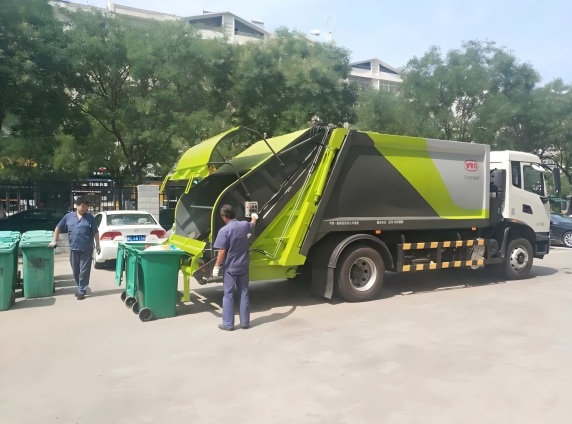
Let’s follow a typical cycle in a rear-loading garbage truck with compactor:
Loading: Waste is manually or mechanically (via a tipper) deposited into the hopper at the rear of the truck.
Initiation: Once the hopper is full or a pre-set time is reached, the operator activates the PTO. Hydraulic pressure builds.
The Packing Stroke: The main packing cylinder extends, driving the packing panel upwards through the hopper. It crushes the waste against a “ceiling” or anvils, breaking down bulky items and compressing the material.
Sweeping & Retraction: The panel continues its stroke, sweeping the now-compacted waste into the main body cavity. It then retracts back to its starting position, clearing the hopper for the next load.
Repetition: This cycle repeats dozens of times per route, continually layering and compressing waste toward the front of the body.
Ejection: At the disposal site, the packer panel is locked, and the ejector panel is activated, sliding the entire dense, block-like load out of the body.
This waste collection vehicle operation process highlights the seamless integration of mechanical force and hydraulic control that defines modern collection.
4. Technological Advancements and Market Trends
The technology behind garbage truck compaction mechanisms is not static. Key trends shaping the B2B market include:
Intelligent Compaction Control: Sensors monitor load density and pressure, automatically adjusting cycle force and frequency to achieve optimal payload without over-stressing the chassis or body—a key feature in smart waste management solutions.
Enhanced Leakage Prevention: Leak-proof waste compactor designs with better sealing around doors and panel edges are critical for maintaining clean streets and complying with environmental regulations regarding leachate.
Noise Reduction: Urban operations demand quieter equipment. Improved hydraulic systems and sound-dampening materials are becoming standard.
Durability & Corrosion Resistance: The use of high-tensile steel, advanced corrosion-resistant coatings for waste trucks, and composite materials extends vehicle life, especially in harsh or coastal environments.
5. Buyer’s FAQ: Key Questions Answered
Q1: What is the typical compaction ratio I should look for in a new truck?
A: It depends on your waste stream. For mixed municipal solid waste, ratios of 3:1 to 6:1 are common. Higher ratios (5:1 or more) are found in advanced high-compaction ratio refuse trucks, ideal for dense urban routes with long haul distances to disposal sites.
Q2: How does the compactor impact the truck’s overall fuel efficiency and maintenance?
A: A well-designed compactor maximizes payload per trip, directly improving fuel efficiency per ton of waste collected. Maintenance primarily focuses on the hydraulic system (fluid, filters, hoses) and the wear parts on the packing panel. Choosing a model with easy service access reduces downtime.
Q3: Are there different compaction mechanisms for side-loaders vs. rear-loaders?
A: Yes. While the hydraulic principle is similar, the geometry differs. Rear loader compactor trucks use a large vertical/horizontal panel. Many automated side loader garbage trucks use a “paddle” or “raked” mechanism that sweeps and crushes waste from the curbside bin directly into the body, often in a continuous motion.
Q4: Can the compactor handle all types of waste?
A: Standard compactors are designed for municipal solid waste. They are not suitable for inert construction debris (like concrete), loose soil, or hazardous liquids. Specialized models exist for recyclables (to avoid over-compressing materials) and organic waste, which may require sealed, leak-proof waste compactor designs.
Ready to Optimize Your Fleet’s Efficiency?
Understanding how a garbage truck compactor works is the first step toward investing in a solution that delivers long-term operational savings and reliability. In a competitive market, the right compaction technology is a strategic asset.
As a leading manufacturer of heavy-duty commercial garbage trucks, we combine robust chassis platforms with state-of-the-art, customizable compaction bodies. Our engineering team focuses on delivering high compaction ratios, fuel-efficient designs, and durable, low-maintenance systems tailored to your specific regional challenges and waste streams.
Contact our expert sales team today for a detailed consultation. Let us provide you with a tailored specification sheet, comparative efficiency data, and show you how our advanced waste compaction technology can reduce your cost per ton and enhance your service sustainability. Request a quote or schedule a virtual product demonstration now.