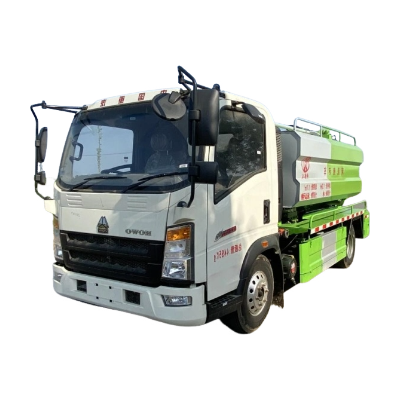
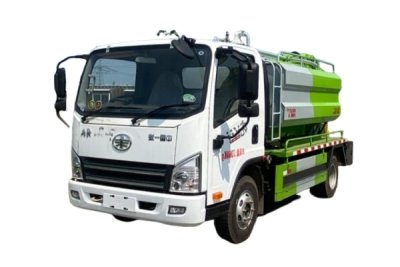
Sewage Suction Truck Buying Guide (Southeast Asia)
Sewage Suction Truck Buying Guide: Sizing, Pumps & Costs for Southeast Asia
In dense Southeast Asian cities — from Jakarta's alley networks to Manila's barangays and Hanoi's old quarter — septic tanks and pit latrines are still emptied largely by hand or by poorly maintained trucks. That is exactly why professional sewer and sewage suction trucks are one of the fastest-growing equipment categories in the region.
But buying one isn't as simple as matching a number on a spec sheet. Tank volume, vacuum pump type, corrosion resistance and running cost all decide whether your truck makes money or sits in the workshop. Here is a plain-language guide to buying the right sewage suction (vacuum) truck for Southeast Asian conditions.
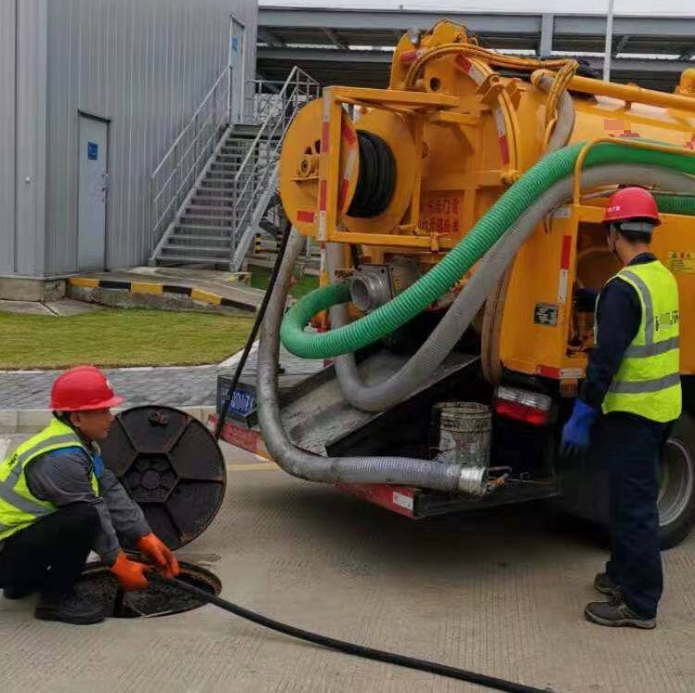
1. How a sewage suction truck actually works
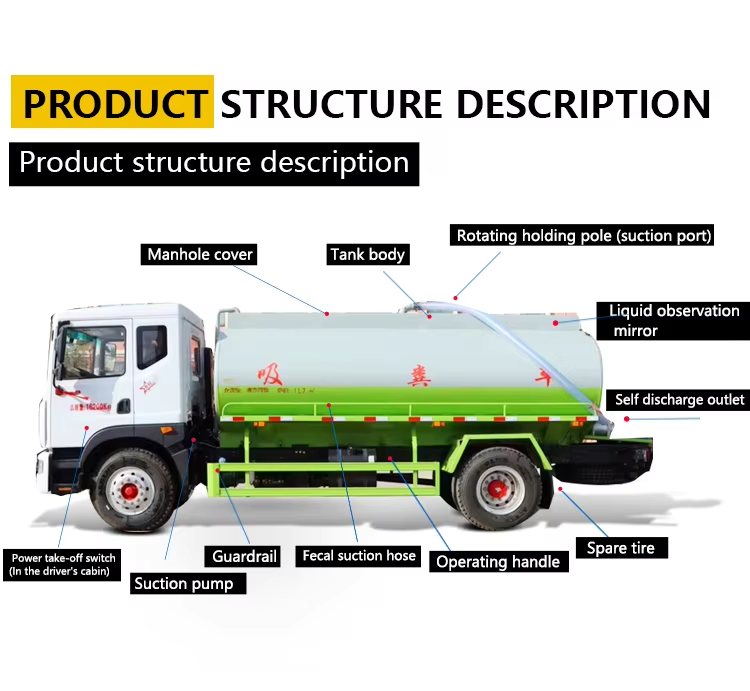
A vacuum truck uses a pump to pull air out of a sealed tank, creating negative pressure that sucks sewage and sludge up through a hose into the tank. When full, it drives to a treatment or disposal point and discharges the load — either by opening the rear valve under gravity, by tilting, or by pressure discharge.
That's the whole principle. The decisions that matter are about capacity, the pump, and the tank material.
2. Tank size: bigger is not automatically better
Pick tank volume by the balance between collection distance and site-to-site travel:
4–6 m³ — sweet spot for septic tanks and narrow urban access in Southeast Asia; easy to maneuver, cheaper to buy and maintain, meets most residential/municipal jobs.
6–8 m³ — for contractors covering longer transfer runs to central treatment plants.
10 m³+ — municipal-scale or long-haul, where a big load offsets long travel time.
Rule of thumb: If your discharge point is far from your collection area, a bigger tank wins (fewer trips). If you do many short jobs in different neighborhoods, the smaller, more agile unit wins. For most Southeast Asian septic-service startups, 4–6 m³ is the practical starting point.
3. Vacuum pump: water ring vs. roots (rotary lobe)
The vacuum pump is the heart of the truck — don't buy on tank size alone.
Water ring (liquid ring) pumps — use water to seal. More forgiving of wet, dirty loads with debris and oil; good reliability for typical sewage work. Best default choice for general cesspool and septic service.
Roots (rotary lobe) blowers — deliver faster evacuation of dry or powdery materials (e.g., fly ash, some industrial powders), but can be worn down faster by wet sludge and debris.
Because Southeast Asian municipal and septic sludge is often wet, oily and debris-laden, a water-ring design is usually the more trouble-free, lower-maintenance pick. Confirm the pump's vacuum depth and evacuation speed with your supplier rather than just its name.
4. Corrosion resistance: the #1 killer of cheap tanks
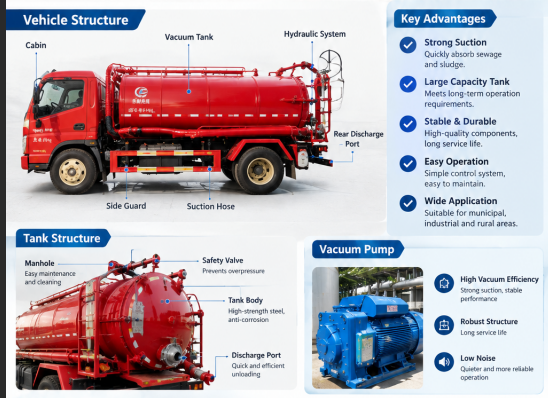
Sludge is not water. Hydrogen sulfide and acids in sewage corrode ordinary steel fast, especially in a hot, humid climate.
Insist on well-coated tank interiors / appropriate steel selection and effective anti-corrosion treatment.
Check drain and accessories (valves, flanges, backflow prevention) are sealed and serviceable — this is where cheap imports start leaking.
Ask about the tank's design head and hose reel quality; these set how many years the truck lasts before major repairs.
A slightly higher purchase price for a properly treated tank almost always pays back in years of added working life.
5. Diesel engine & chassis for local roads
Choose a cab-chassis brand with an established dealer/parts presence in your country (e.g., Dongfeng, FAW, HOWO/Sinotruk) — the cheapest chassis is a false economy if you can't get parts quickly.
Confirm the emission standard your market requires (many Southeast Asian cities now require Euro 4 / Euro 5 or local equivalents). Trucks that can't be locally registered will cost you at the border, not save you money.
Robust suspension for real street conditions, and a PTO (power take-off) correctly matched to drive the vacuum pump.
6. Realistic budget picture (to budget your quote requests)
Because prices move with configuration, exchange rates and chassis, don't chase one number. Instead budget by rule-of-thumb brackets so you can compare like-for-like quotes:
Compact septic unit (4–5 m³) — the entry/most common band for startups and small contractors.
Medium 6–8 m³ municipal — mid band, modular choice for growing fleets.
Large 10 m³+ / combo (vacuum + high-pressure jetting) — the top band: highest capability, also highest price. The combo version adds line-cleaning so one truck does both suction and flushing of blocked drains.
Ask any supplier for an itemized quote: chassis price + tank/installation + vacuum pump + shipping to your port + any local taxes, so you compare total landed cost — not just the vehicle sticker price.
7. New vs. used — a real question in Southeast Asia
Buying used abroad looks cheap but: local registration of foreign right-hand/left-hand mismatch, engine that sat idle, and no warranty often erase the savings — plus parts archaeology for an unknown service history.
Buying a new, properly specified truck gives you warranty, correct emissions documentation, full spare-parts support and predictable running costs.
For a septic business that depends on a truck that starts every day, the "total cost of ownership" usually favors a sound new unit over an aging used import. If budget is genuinely tight, a simpler, smaller new truck is usually a safer buy than a bigger second-hand one.
8. Checklist before you order
Tank size matched to my collection distance (4–6 m³ unless long-haul)
Water-ring vacuum pump for wet/sludge loads — or confirmed faster option for my material
Anti-corrosion treated tank + sealed valves
Chassis & parts support available in my country
Correct emission standard for local registration
Itemized landed-cost quote (truck + freight + taxes), not just a "unit price"
English/spare-parts docs + lead time to my port
Warranty & after-sales terms in writing
9. Bottom line
A sewage suction truck is a dependable money-maker when you buy the one that matches how far you drive, what you pump, and what you can service locally. Size it to your route, prefer a water-ring pump for wet sludge, and never sacrifice tank corrosion protection to save on the first invoice.
Tell us the jobs you run — your typical sludge, average distance to discharge, and local emission rules — and we'll recommend the right volume and pump and send a spec sheet plus delivered price for your comparison.
Call to Action (form area at the end of the text)
Get a sewage suction truck spec + delivered quote
Describe your typical job (septic only? long-haul? need drain jetting too?) — we'll reply within 24 hours with a matched model, full specs and the landed price to your port.
👉 Click "Request a Quote" or message us on WhatsApp.
PDF: Sewage / vacuum truck technical comparison available on request.
This is the second complete article. If you want me to post the whole article like this for another article, or show the remaining 3~8 articles all at once, just let me know.