How to implement a new model of urban and rural waste management for hanging bucket garbage trucks
In the process of urban-rural integration development, the problems of "difficult collection and transportation, low efficiency, and high cost" in garbage management have long constrained the improvement of living environment. As the core equipment connecting the front-end garbage bin and the back-end transfer station, the hanging bin garbage truck is promoting the transformation of urban and rural garbage management from "extensive transfer" to "refined closed-loop" through "hardware upgrade+mode innovation+digital empowerment", becoming a key lever to solve the problem of urban and rural garbage management.
1、 Refactoring the collection and transportation system: from "scattered and inefficient" to "comprehensive coverage"
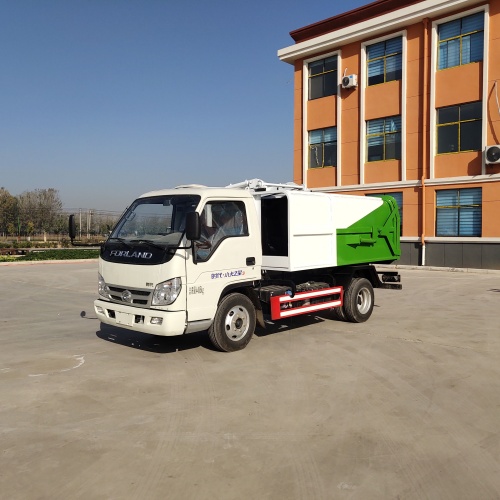
Traditional urban and rural garbage collection and transportation rely on manual hand carts or open top tricycles, which have pain points such as "leakage" and "low transportation frequency". The hanging bucket garbage truck, with "bucket truck docking" as its core, has built a standardized chain of "household deployment village collection town transportation":
-Rural scenario: In response to the scattered distribution of natural villages and narrow roads, small bucket trucks (such as electric four-wheel vehicles with a width of ≤ 1.5 meters) can penetrate into 2-meter-wide village alleys to achieve "fixed-point parking and one click loading and unloading".
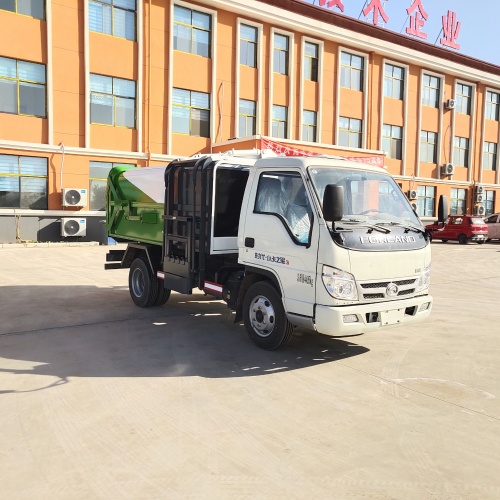
-Urban scenario: In old residential areas, alleys and other "capillary" areas, side mounted bucket trucks (with a working width only 14 centimeters beyond the carriage) solve the problem of traditional large vehicles being unable to enter and stop steadily. The pilot project of "Kitchen Waste Special Line Collection and Transportation" in Zhuhai High tech Zone has achieved the transportation of kitchen waste through "fixed time and precise docking" with catering stores using bucket trucks, reducing the mixing and transportation rate from 45% to 8%.
This collection and transportation mode of "matching large and small vehicle models and unifying urban and rural standards" enables garbage to be "standardized" from the source, avoiding secondary pollution and laying a hardware foundation for urban and rural garbage management.
2、 Technology Empowered Management: From "Manual Supervision" to "Digital Intelligent Control"
The intelligent upgrade of self loading and unloading garbage trucks promotes the shift of governance mode from "experience driven" to "data-driven":
a. Full process digital supervision: Real time monitoring of vehicle trajectory, operation duration, garbage weight, and other data through vehicle mounted Beidou/GPS positioning system, weighing sensors (error ≤ 3%), and cameras. More than 200 bucket trucks in Jizhou District, Hengshui City will be connected to the smart sanitation platform, achieving "intelligent planning of transportation routes, automatic alarm of abnormal operations, and dynamic analysis of garbage volume". The government's regulatory costs will be reduced by 16%, and the empty driving rate of vehicles will be reduced by 22%.
b. Accurate classification and transportation: In response to the needs of urban garbage classification, bucket trucks can be equipped with a "multi box classification and transportation" function (such as one truck with two buckets, different color boxes to distinguish recyclable materials from other garbage), combined with technologies such as "bucket truck color correspondence" and "electronic tag recognition", to ensure a closed loop of "classification placement classification collection classification processing". Zibo City is promoting the use of enclosed bucket trucks instead of open end vehicles. Through the design of box sealing strips and anti drip chassis, the leakage rate of leachate during transportation is controlled from 15% to within 2%.
c. New energy transformation improves efficiency and reduces costs: Electric bucket trucks (with a range of 30-250 kilometers) have significant advantages in short distance transportation between urban and rural areas. The electric four-wheel vehicle model (4000W motor) developed by Sichuan Shuxing Faupai has a single kilometer energy consumption of only 0.3 yuan, a 60% reduction in cost compared to diesel vehicles, and a noise level below 60 decibels, reducing interference with residents.
With the support of technology, self loading and unloading garbage trucks are not only transportation tools, but also data collection nodes, providing intelligent support for urban and rural waste management with a "decision-making map and supervision network".


3、 Innovative Mechanism Collaboration: From "Government Domination" to "Diversified Governance"
The promotion of bucket trucks has spurred innovation in governance mechanisms, breaking the traditional model of "government single investment":
-Marketization of "separation of cleaning and transportation": Hengshui Jizhou District outsources rural garbage collection and transportation to third-party enterprises, and the government replaces "fixed personnel wages" with "pay per vehicle". After introducing enterprise competition, the annual management cost of the whole district has decreased from 12 million yuan to 10.08 million yuan, while forcing enterprises to optimize vehicle scheduling and improve operational efficiency.
-Villager participation mechanism: Through "assigning garbage bin numbers to households" and "collecting garbage bin trucks at regular intervals", guide villagers to develop the habit of "fixed-point disposal and classification into bins". Saihan Wusu Village in Hainan District has implemented the "three guarantees in front of the door+point exchange" policy, where bucket trucks record the compliance of each household's garbage disposal during daily door-to-door collection. Points can be exchanged for daily necessities, and the accuracy of garbage classification among villagers has increased from 30% to 75%.
-Cross regional collaborative governance: In management blind spots such as urban-rural fringe areas, bucket trucks are used to achieve "standardization and process connectivity". Baoding City has learned from the experience of Hengshui and incorporated villages within 20 kilometers of the city into the "urban environmental sanitation integration" system. Through the unified configuration of bucket trucks and unified collection and transportation standards, the problem of "mutual pushing of garbage at village boundaries" has been solved, and the regional garbage removal coverage rate has increased from 82% to 98%.
4、 Cracking pain points: from "end of pipe processing" to "source reduction"
The application of hanging bucket garbage trucks not only improves the efficiency of collection and transportation, but also promotes the extension of governance towards "source reduction":
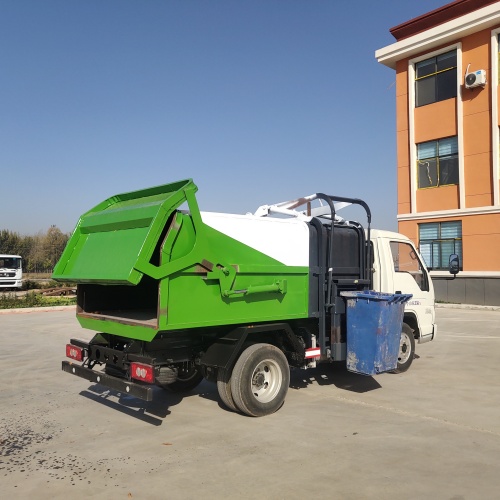
-Hardware forcing classification habits: The design of "one truck, one bucket" bucket trucks allows residents to intuitively see the transportation paths of different types of garbage, strengthening their awareness of classification. For example, Tongzhou District in Beijing promoted the use of "blue bins (recyclable materials) - green bins (kitchen waste) - gray bins (other waste)" corresponding to different colored bucket trucks for community transportation, resulting in a 40% increase in residents' active classification rate within three months.
-Cost transmission mechanism: By using a bucket truck weighing system to record the amount of garbage generated by each unit and community, it provides data basis for "garbage metering and charging". The pilot project of "charging by weight" in Shangcheng District, Hangzhou has reduced the monthly average waste volume of a certain catering street from 80 tons to 55 tons. Merchants have taken the initiative to reduce transportation costs through reduction and pre-treatment.

5、 Future Outlook: From "Single Equipment" to "Ecological Hub"
With the promotion of the "zero waste city" and "dual carbon goals", bucket trucks are upgrading from "single function" to "scene integration":
-Multiple scenarios of "bucket hanging+": bucket hanging vehicles equipped with compression devices (such as the fully automatic bucket holding model of Kaili Group) can achieve the integration of "collection compression transportation", reducing the land occupation of transfer stations; Linked with intelligent garbage bins, the collection route is automatically planned through overflow alarm, and an intelligent terminal called "Bucket Car Network" is constructed.
-Integration of new energy and circular economy: Electric bucket trucks can serve as "mobile energy storage units" to store electricity during low charging periods and feed back into the power grid during peak periods; The car body is made of lightweight materials (such as aluminum alloy frame), with a recycling rate of over 90% after scrapping, practicing "full lifecycle environmental protection".
conclusion
The 'small innovation' of hanging bucket garbage trucks has leveraged the 'big change' in urban and rural garbage management. It is not only a "physical bridge" connecting front-end advertising and back-end processing, but also an "ecological link" connecting technological innovation, mechanism reform, and public participation. With hardware iteration and mode optimization, this new governance model of "bucket car collaboration" is providing a replicable "Chinese solution" for upgrading urban and rural living environments and achieving the "dual carbon" goal.